Wednesday, 18 August 2010
New bridges over Dartmouth Avenue and Monksdale Road - Public Event Wednesday 18th August
Click here for details
Thursday, 24 June 2010
Whaaat!?!
Seen on the fence ...
first shipworm, and now an enigma.
Oh, hang on, its not an enigma, it's a qr code.
Bath's Spot the Lion has some of these ...
It looks like the project's getting some information up at the worksite. Good. Now, what does it say?
First one to post the answer in the comments gets ... a big collective grin from the committee!
Sunday, 20 June 2010
Three new friends of the Two Tunnels route
The lack of activity on the ground does give the impression that everything's at a halt. Behind the scenes though, there's the nitty gritty work on the planning of the exact form of the route - the project plan isn't slipping all round the calendar, physical work is currently booked to restart in the autumn.
Meanwhile, up at 'The fence' at Devonshire Tunnel, we're looking out signage to inform visitors to the site about the project and its goals. It's quite usual for projects to use any hoardings to proudly announce the constructing partners, contractors and an outline project plan, but people probably thought that no one would visit Linear Park to see what's going on. Not so, as 'The fence' has had visitors from far and wide, as well as from Bath residents.
Bath's Holborne Museum's Extension project (their site's pictured to the right, planted firmly at the end of Great Pulteney Street and 'A bit high viz') even pins the projected completion date on its fence.
We're pretty proud of the Two Tunnels project, so we'll see what we can bring about at the Devonshire Tunnel work site. It may be less prominently sited than the Holborne but it still has its visitors, and the fence will be in place for this year and most of next.
Which brings us to the other problem - the fence blocked any hope of a view of the works.
It's not unusual ... for a construction site to have viewports in its perimeter fence.
Thanks to Nigel Bryant and a Sunday morning, visitors can now view the site through no less than three holes, and this being the Two Tunnels project, we think of them as three new supporters who each have a name.
Of course we'd never suggest that these are used in the same way as the once common fairground sideshow, with willing volunteers pelted with wet sponges from the other side as a fundraiser ...
... that's because we'd be those volunteers ...
The final photos show the fence with the viewports, and the newly greened-over approach cutting. Behind it, the topsoil that dressed the cutting's sides has greened over well. You might notice that the tunnel portal's excavation stopped slightly short of its full depth. This is because it was found to be about a metre more deeply buried than initial estimates.
To deepen the excavation would have either implied steeper cutting sides - and they were quite old fashioned enough already - or far more excavation and hence spoil to remove, so it was decided to stop slightly short of the 'Trackbed depth' - at a point at which the tunnel portal will still provide more than adequate headroom.
There's something else. In this photo, can you find the moon?
Meanwhile, up at 'The fence' at Devonshire Tunnel, we're looking out signage to inform visitors to the site about the project and its goals. It's quite usual for projects to use any hoardings to proudly announce the constructing partners, contractors and an outline project plan, but people probably thought that no one would visit Linear Park to see what's going on. Not so, as 'The fence' has had visitors from far and wide, as well as from Bath residents.
Bath's Holborne Museum's Extension project (their site's pictured to the right, planted firmly at the end of Great Pulteney Street and 'A bit high viz') even pins the projected completion date on its fence.
We're pretty proud of the Two Tunnels project, so we'll see what we can bring about at the Devonshire Tunnel work site. It may be less prominently sited than the Holborne but it still has its visitors, and the fence will be in place for this year and most of next.
Which brings us to the other problem - the fence blocked any hope of a view of the works.
It's not unusual ... for a construction site to have viewports in its perimeter fence.
Thanks to Nigel Bryant and a Sunday morning, visitors can now view the site through no less than three holes, and this being the Two Tunnels project, we think of them as three new supporters who each have a name.
- Arthur Ole
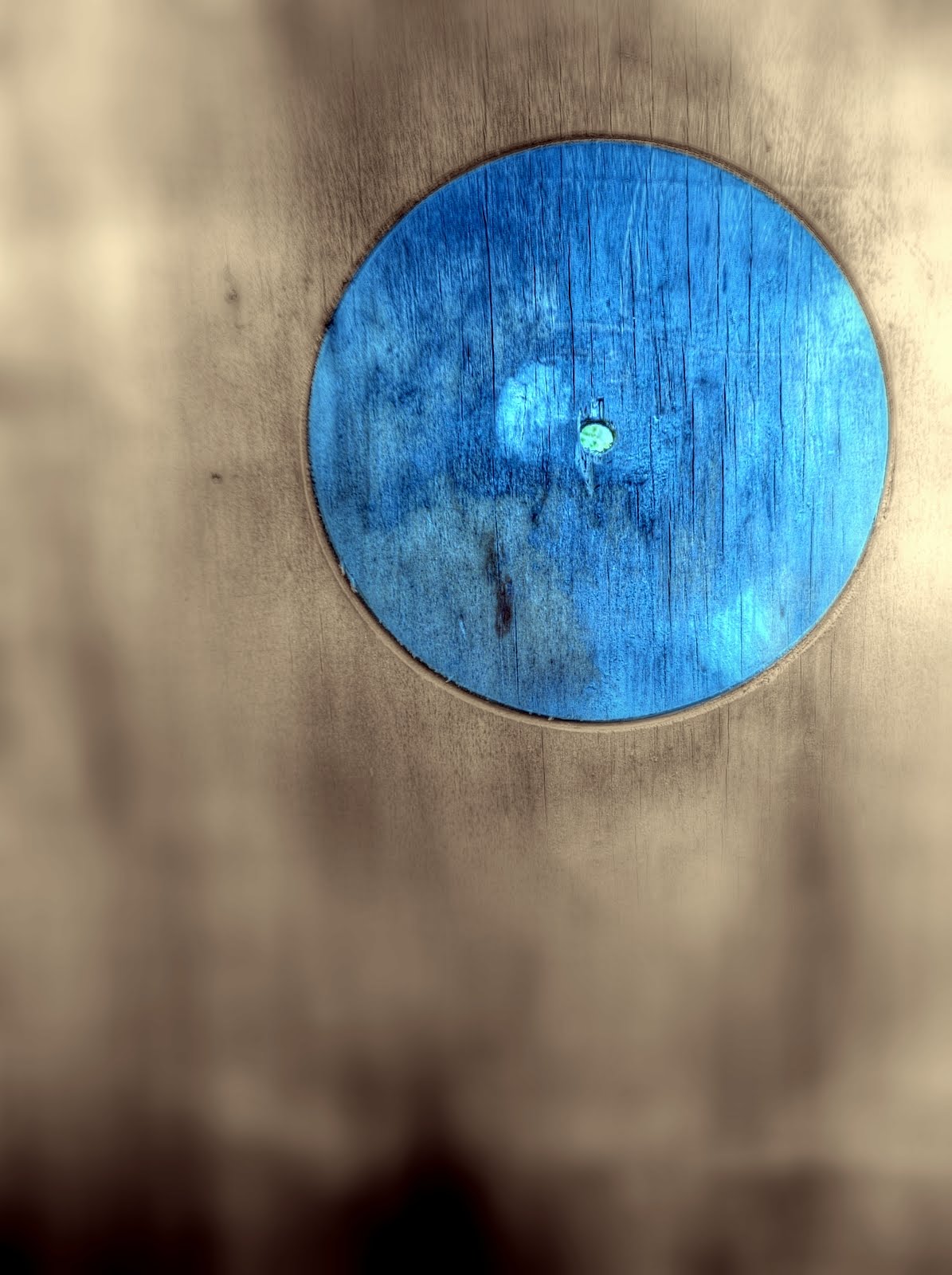
- The first attempt. Something went terribly wrong and the air turned blue. The hole's image has been tinted blue in honour of the work that went into this first attempt and the language it provoked.
- Ann Ole
- The first successful hole, this one's for tall people, Ann Ole is well off the ground.
- Anna Ver Ole
- Thinking that small people would also like to see the works, Nigel cut a third hole at a suitable height ...
Of course we'd never suggest that these are used in the same way as the once common fairground sideshow, with willing volunteers pelted with wet sponges from the other side as a fundraiser ...
... that's because we'd be those volunteers ...
The final photos show the fence with the viewports, and the newly greened-over approach cutting. Behind it, the topsoil that dressed the cutting's sides has greened over well. You might notice that the tunnel portal's excavation stopped slightly short of its full depth. This is because it was found to be about a metre more deeply buried than initial estimates.
To deepen the excavation would have either implied steeper cutting sides - and they were quite old fashioned enough already - or far more excavation and hence spoil to remove, so it was decided to stop slightly short of the 'Trackbed depth' - at a point at which the tunnel portal will still provide more than adequate headroom.
There's something else. In this photo, can you find the moon?
Sunday, 23 May 2010
Back to the future: the making of Linear Park
Well, things on the construction front are at a stand - the project plan always did indicate a bit of a pause at this point, but in several ways we'd rather not have had this further opportunity to gather our thoughts - while the project itself perhaps risks a stall.
I'm checking its pulse, as there are doubtless still people who think that the clearly expressed wish by a great many for a 'Two Tunnels route' is bothersome, counts for nothing, and they might be tempted to encourage the idea to quietly drift off to sleep. If needed, the supporters group has to step in as the alarm clock. The more supporters, the louder the clock can ring, see the postscript ...
The most recent task on the Devonshire Tunnel site was to erect tidy fencing to the top of the tunnel cutting, and a temporary security fence across the cutting itself, behind which further work can take place.
Curiously though, the gate in that fence is of 'Garden gate' proportions. We'd find it encouraging to see a gate of 'Path machinery' proportions.
The first image shows the posts for the new fence in place and awaiting rails and sheets of ply. The second is courtesy of a visitor - Alexander Cunningham - it captures the atmosphere of this part of the route as well as any we've seen. Now the fence itself is blocking the view, we've requested that a viewing port be cut in it, as is common at construction sites that are of public interest - and we've provided the source for some signage as well.
Is this journey really necessary?
Our serious campaigning began in March 2006 and included some market research:
'We may think this is a good idea, but is there wide public support for this, the support to justify the time and investment?'
The answer was a resounding 'Yes' - for all sorts of reasons.
That view was reaffirmed by the public support shown for the planning application, and then for the Sustrans Connect 2 project.
After which, the King Bladud's Pigs took off in all sorts of ways, in part because of the cause for which they were fundraising. The Pigs benefitted the City - visitor numbers well up in what was a wet summer - and themselves have laid the foundations for Bath's 2010 arts project, 'Lions of Bath'. There's Elvis (above) - find him in Bath's Guildhall Market. The lions project will be a fundraiser for a number of local charities, and, like the pigs, the project will build and strengthen a network of contacts between diverse groups of people who would otherwise likely not meet - a good way to strengthen one of the cornerstones of economic activity. Do enjoy them if you can.
The photo above's the 'Two Tunnels Pig' - from the artist Sophie Howard -painted after a research visit to shade-dappled Lyncombe Vale one day in July 2008 - and given the speed at which the Two Tunnels project is progressing, the placement of the hedgehog is entirely appropriate! So is the inclusion of a person using a wheelchair - opportunities for independent exploration can be few and far between, and the route will offer a great resource if you happen to be in a wheelchair.

So, while we understand the institutional reluctance we've seen along the way, its all the more frustrating that while Sustrans and B&NES came to us very quickly and said that they'd support this, it's then taken so long to get so much as a spade into the ground - and now with the first work complete, things have now halted.
Speaking of spades, when it went into the ground, it was partly of our making - that's the Two Tunnels' ceremonial spade, fashioned in stainless steel in China - and decorated by Nigel Bryant in Bath on the morning of the 8th March. You'll see a small design at the bottom right of the blade, can you guess what it represents?
But ... back to this pause. It is in the project plan ... so we'll attempt to put to one side the fact that this small project - just six months work - could be done and dusted before the completion of Southgate, or the Holburne Museum extension ...
Let's abandon the bike for a moment and fire up the DeLorean, rolling it down that slope to the tunnel to turn the clock back to the seventies. Bath Library contains just a few documents relating to the decision taken by the then Bath City Council that rather than use the old line for piecemeal redevelopment, much would become a community resource - Linear Park.
This was an unusual and enlightened move for the time: many old lines in town and city were cannibalised at that time. A present day walk along the route could easily now find a new road between Bellotts Road and Dartmouth Avenue, patches of housing, an expanded industrial estate at Monksdale Road, and a small housing estate on the site of the infilled Devonshire Tunnel portal, ninety odd years of an historic and characterful railway reduced to a concealed manhole cover in a suburban garden.
The 'Linear Park vision' didn't actually extend to the line's tunnels: those were perceived as a hazard. While it's now more commonplace to acknowledge the benefits and bring paths through old rail tunnels where practicable, even a few years ago this was very much against accepted practice. This document does suggest retaining the first few feet of Devonshire Tunnel as a 'shelter' - something that would have been more successful in the seventies than in today's society, where through routes work, but cul-de-sacs may not.

The four page pamplet on the left has details of the original proposals to deal with what was rapidly becoming a dumping ground. Once plans were made, the council having bought the three stretches of line from British Rail for a token sum, work started. Unfortunately, while a lot of the demolition tasks were completed, 1973 saw the price of oil abruptly quadruple, (the graph on the right's from Wikipedia, note what happens in 1973). Away went the budget, with a conseqent hit on the 'Amenity-creation' factor.
While the demolition and earth moving component of the Linear Park task was completed, much of the landscaping didn't survive the oil price shock. The resulting Linear Park was a bit of an obstacle course even on foot, and the current resource is the product (and credit) of years of piecemeal improvement work from B&NES Parks department and local residents. The Two Tunnels campaign has raised Linear Park's profile, and it is now rather more easy to negotiate than it was when the campaign started. This of course may simply be a coincidence.™
While the document intended a stretch of parkland and a small display of railway artefacts in front of a sealed Devonshire Tunnel, when the work was carried out, to the great surprise of some people, the tunnel mouth was simply buried, seven years after it saw its last train.
This year's work at Devonshire Tunnel has, so far, part-realised the original plan - albeit with a buried telegraph post standing in for the 'Railway artefacts' and many people have noticed how pleasant a stretch this part of the route already makes - between Maple Grove bridge and the tunnel portal. There's something to be said for landscaping to this section to somewhat clear the view of the tunnel from the bridge and vice versa - so we're looking forward to further work, now that the major physical obstacle to completion of the route is out of the way.
A postscript - while the document touches on the Lyncombe Vale stretch of the route "... which is already extremely attractive and on which only the minimum treatment will be necessary" the proposal misses the fact that to this day, while it's an open space, public access is limited to the reasonably fit and agile. The Two Tunnels project will address this, at least by opening up the subterranean approaches!
In the event, the only treatment meted out to Lyncombe Vale appears to have been the sealing of Devonshire's south portal - and even this may have been done by its owners British Rail, it is they who have maintained the tunnel to the present day. The builders of the small steel grill replacement bridge close to Devonshire Tunnel are a mystery - though perhaps a reader knows more.
The report also recommended the sealing of Combe Down "Which will also be sealed within twelve or fifteen feet of its entrance" - they were fond of that approach.
As it happened, Combe Down wasn't sealed for a decade, and a walk through Combe Down Tunnel became part of a regular outing for very many years - when it closed its historic national collection of crisp packets and the odd beer can were encapsulated in the darkness.
The last paragraph of the article is unsettling, suggesting as it does the completion of Linear Park as a series of linked project over a time period of five or six years. Bearing in mind that the engineer who would later complete the Severn Rail Tunnel organised the entire S&D new line into being in less than two - using 3000 men with hand tools ... perhaps in the 21st century we could aspire to something better, given that the Two Tunnels route is a small fraction of the length, and minimal construction is involved?
You are invited to join us in regarding the clock as having started ticking in early March 2006.
It might be that once again we'll need the supporters to speak out in favour of the route - we've a great many, but you're not all signed up to our mailing list - it's always somehow easier to build up big numbers campaigning against something rather than for it. If you know someone who'd be keen to support the Two Tunnels route, now would be a good time to talk them round to joining either our mailing list or the 400+ people on our Facebook group.
I'm checking its pulse, as there are doubtless still people who think that the clearly expressed wish by a great many for a 'Two Tunnels route' is bothersome, counts for nothing, and they might be tempted to encourage the idea to quietly drift off to sleep. If needed, the supporters group has to step in as the alarm clock. The more supporters, the louder the clock can ring, see the postscript ...
The most recent task on the Devonshire Tunnel site was to erect tidy fencing to the top of the tunnel cutting, and a temporary security fence across the cutting itself, behind which further work can take place.
Curiously though, the gate in that fence is of 'Garden gate' proportions. We'd find it encouraging to see a gate of 'Path machinery' proportions.
The first image shows the posts for the new fence in place and awaiting rails and sheets of ply. The second is courtesy of a visitor - Alexander Cunningham - it captures the atmosphere of this part of the route as well as any we've seen. Now the fence itself is blocking the view, we've requested that a viewing port be cut in it, as is common at construction sites that are of public interest - and we've provided the source for some signage as well.
Is this journey really necessary?
Our serious campaigning began in March 2006 and included some market research:
'We may think this is a good idea, but is there wide public support for this, the support to justify the time and investment?'
The answer was a resounding 'Yes' - for all sorts of reasons.
That view was reaffirmed by the public support shown for the planning application, and then for the Sustrans Connect 2 project.
After which, the King Bladud's Pigs took off in all sorts of ways, in part because of the cause for which they were fundraising. The Pigs benefitted the City - visitor numbers well up in what was a wet summer - and themselves have laid the foundations for Bath's 2010 arts project, 'Lions of Bath'. There's Elvis (above) - find him in Bath's Guildhall Market. The lions project will be a fundraiser for a number of local charities, and, like the pigs, the project will build and strengthen a network of contacts between diverse groups of people who would otherwise likely not meet - a good way to strengthen one of the cornerstones of economic activity. Do enjoy them if you can.
The photo above's the 'Two Tunnels Pig' - from the artist Sophie Howard -painted after a research visit to shade-dappled Lyncombe Vale one day in July 2008 - and given the speed at which the Two Tunnels project is progressing, the placement of the hedgehog is entirely appropriate! So is the inclusion of a person using a wheelchair - opportunities for independent exploration can be few and far between, and the route will offer a great resource if you happen to be in a wheelchair.

So, while we understand the institutional reluctance we've seen along the way, its all the more frustrating that while Sustrans and B&NES came to us very quickly and said that they'd support this, it's then taken so long to get so much as a spade into the ground - and now with the first work complete, things have now halted.
Speaking of spades, when it went into the ground, it was partly of our making - that's the Two Tunnels' ceremonial spade, fashioned in stainless steel in China - and decorated by Nigel Bryant in Bath on the morning of the 8th March. You'll see a small design at the bottom right of the blade, can you guess what it represents?
But ... back to this pause. It is in the project plan ... so we'll attempt to put to one side the fact that this small project - just six months work - could be done and dusted before the completion of Southgate, or the Holburne Museum extension ...
This was an unusual and enlightened move for the time: many old lines in town and city were cannibalised at that time. A present day walk along the route could easily now find a new road between Bellotts Road and Dartmouth Avenue, patches of housing, an expanded industrial estate at Monksdale Road, and a small housing estate on the site of the infilled Devonshire Tunnel portal, ninety odd years of an historic and characterful railway reduced to a concealed manhole cover in a suburban garden.
The 'Linear Park vision' didn't actually extend to the line's tunnels: those were perceived as a hazard. While it's now more commonplace to acknowledge the benefits and bring paths through old rail tunnels where practicable, even a few years ago this was very much against accepted practice. This document does suggest retaining the first few feet of Devonshire Tunnel as a 'shelter' - something that would have been more successful in the seventies than in today's society, where through routes work, but cul-de-sacs may not.

While the document intended a stretch of parkland and a small display of railway artefacts in front of a sealed Devonshire Tunnel, when the work was carried out, to the great surprise of some people, the tunnel mouth was simply buried, seven years after it saw its last train.
A postscript - while the document touches on the Lyncombe Vale stretch of the route "... which is already extremely attractive and on which only the minimum treatment will be necessary" the proposal misses the fact that to this day, while it's an open space, public access is limited to the reasonably fit and agile. The Two Tunnels project will address this, at least by opening up the subterranean approaches!
In the event, the only treatment meted out to Lyncombe Vale appears to have been the sealing of Devonshire's south portal - and even this may have been done by its owners British Rail, it is they who have maintained the tunnel to the present day. The builders of the small steel grill replacement bridge close to Devonshire Tunnel are a mystery - though perhaps a reader knows more.
The report also recommended the sealing of Combe Down "Which will also be sealed within twelve or fifteen feet of its entrance" - they were fond of that approach.
As it happened, Combe Down wasn't sealed for a decade, and a walk through Combe Down Tunnel became part of a regular outing for very many years - when it closed its historic national collection of crisp packets and the odd beer can were encapsulated in the darkness.
The last paragraph of the article is unsettling, suggesting as it does the completion of Linear Park as a series of linked project over a time period of five or six years. Bearing in mind that the engineer who would later complete the Severn Rail Tunnel organised the entire S&D new line into being in less than two - using 3000 men with hand tools ... perhaps in the 21st century we could aspire to something better, given that the Two Tunnels route is a small fraction of the length, and minimal construction is involved?
You are invited to join us in regarding the clock as having started ticking in early March 2006.
It might be that once again we'll need the supporters to speak out in favour of the route - we've a great many, but you're not all signed up to our mailing list - it's always somehow easier to build up big numbers campaigning against something rather than for it. If you know someone who'd be keen to support the Two Tunnels route, now would be a good time to talk them round to joining either our mailing list or the 400+ people on our Facebook group.
Monday, 19 April 2010
Northern Link to the Bath to Bristol Railway path
Slightly off topic as construction of this section is some way off, but Rob was enquiring about getting to and from the Bath to Bristol Railway path across the Lower Bristol Road. As this is something that has had little exposure I thought it might be worth a posting, albeit well in advance of any work starting. (nb - this section will be managed by B&NES as part of the Bath Transport Package (BTP) which is currently held up by legal challenges over the compulsory purchase elements of the Rapid Transit Route. If BTP funding were withdrawn as a result then this section would need to be funded from the annual Government transport grant which cannot be guaranteed. So, we await developments.)Access would be via Inverness Road, which runs into Burnham Road.
Above is part of a draft plan produced by The Council Highways Dept (with my additional scribbling). It shows:
- Where Burnham Road joins the Lower Bristol Road, a widened [shared use] footway/cycleway would be created towards Jews Lane to the west.
- The current ‘Pelican’ crossing would be upgraded to a ‘Toucan’ crossing.
- The short section on the northern side of the road to Fieldings Road bridge would become a [shared use] Footway/Cycleway.
- The Fielding Road Bridge would then give access across the river to the Bath to Bristol Railway path.
Another link into the city centre via the Western Riverside Development has also been discussed but is a bit more complicated and no plans are yet in place.
Note also the Herman Miller building that runs along the length of this section which LIDL has applied for planning permission (Reference 09/02140/FUL) to turn into one of their stores. Well done them in placing a bike store at the western end of the proposed building, thereby making life a little easier for cyclists. It has also been requested that, if the planning application is successful, the company should site any refreshment facility at the western end of the building to provide easy access to the many hungry and thirsty pedestrians and cyclists passing by!
Thursday, 15 April 2010
The next dig thing
Just a few short weeks, and the new route's brought great changes to the top end of Linear Park. The current newcomer being what appears to be a red carpet, rolled out perhaps to honour two particular teenagers who along with their footsteps appear to have been quietly haunting the place.
The Devonshire Tunnel excavation isn't representative of the work needed to the rest of the Two Tunnels route - most of it doesn't involve excavating to a depth of around seven metres.
We're grateful for the forbearance of the immediate neighbours to this task, some of this work has not been quiet, it's involved the removal of trees, and much has invoked what have been described as 'Dragons' or 'Dinosaurs' rather than the 3000 or so pairs of hands that originally built the railway. (At other times we know them as diggers)
At the same time, many have seen the work first hand, and have also enjoyed the sight of the surprising number of visitors who've been up to the various fences to view the emerging tunnel, now in plain view, albeit behind the block wall. Some of these visitors have travelled a surprising distance to see the work in progress - if you can beat Glastonbury (by bus), do tell us - post a comment.
This phase of the contract being almost at an end, we continue to be grateful to the contractors Hope and Clay for turning out such a professional job - as has been remarked on in the steering group, something that was remarked on in the latest steering group meeting notes. This has been more than an ordinary excavation and as at least one visitor has observed, in the eyes of many thousands of people the old railway between Bath and Midford deserves to be as much of a world heritage site as any other location with that distinction. It's also the (unintentionally beautiful) product of a great deal of human endeavour, and while it's most unlikely to host trains once more, it is at least being thought of in one piece again.
Not that the old line can't produce a few surprises as far as trains are concerned. Late on Wednesday afternoon, a small party from the Two Tunnels committee visited the excavation courtesy of a neighbour. We were a little late, but at the moment we stepped up to the neighbour's garden fence and the portal of Devonshire Tunnel hove into view, a loco whistle from 35028 Clan Line sounded clearly across Oldfield Park from the present-day line through Bath - another truly scalp-tingling moment. To cap this, five minutes later, down in the cutting in warm sunlight, a heavy beat as the loco accelerated from its stop at Bath Spa caused us all to glance down beneath Maple Grove bridge - just to be sure.
So, what's next? Several weeks hiatus, especially because we're awaiting a bat licence, and the block wall will be coming down. Devonshire Tunnel will in due course be providing access to the Lyncombe Vale section, but before that, remedial work both to the tunnel and its portals. Whilst it's in surprisingly good condition after 35 or so years protection beneath the ground, the stone is very wet and will be drying for months, and it also merits a certain amount of removal of harmful concrete pointing and replacement with something more sympathetic. So, onward and upward, or in the case of the ramp, downward ...
The Devonshire Tunnel excavation isn't representative of the work needed to the rest of the Two Tunnels route - most of it doesn't involve excavating to a depth of around seven metres.
We're grateful for the forbearance of the immediate neighbours to this task, some of this work has not been quiet, it's involved the removal of trees, and much has invoked what have been described as 'Dragons' or 'Dinosaurs' rather than the 3000 or so pairs of hands that originally built the railway. (At other times we know them as diggers)
At the same time, many have seen the work first hand, and have also enjoyed the sight of the surprising number of visitors who've been up to the various fences to view the emerging tunnel, now in plain view, albeit behind the block wall. Some of these visitors have travelled a surprising distance to see the work in progress - if you can beat Glastonbury (by bus), do tell us - post a comment.
This phase of the contract being almost at an end, we continue to be grateful to the contractors Hope and Clay for turning out such a professional job - as has been remarked on in the steering group, something that was remarked on in the latest steering group meeting notes. This has been more than an ordinary excavation and as at least one visitor has observed, in the eyes of many thousands of people the old railway between Bath and Midford deserves to be as much of a world heritage site as any other location with that distinction. It's also the (unintentionally beautiful) product of a great deal of human endeavour, and while it's most unlikely to host trains once more, it is at least being thought of in one piece again.
So, what's next? Several weeks hiatus, especially because we're awaiting a bat licence, and the block wall will be coming down. Devonshire Tunnel will in due course be providing access to the Lyncombe Vale section, but before that, remedial work both to the tunnel and its portals. Whilst it's in surprisingly good condition after 35 or so years protection beneath the ground, the stone is very wet and will be drying for months, and it also merits a certain amount of removal of harmful concrete pointing and replacement with something more sympathetic. So, onward and upward, or in the case of the ramp, downward ...
Sunday, 11 April 2010
Time for some Drainage
The blog post titles just get more gripping, eh?
When first visiting the excavation just a few weeks ago at the end of a cold March day, I remarked that the new excavation was drier underfoot than I expected. The person in charge pointed to a strip of freshly exposed stuff that looked much the same as the rest: 'There's a drain'. I'd not noticed the filled trench - filled with rather grubby railway-ballast-sized stuff, and not easy to see for the uninitiated. The contractors would have continued to put their observational skills to work for the following weeks as they excavated and in some places rearranged the material in the cutting, when they weren't prising it off the tunnel portal. Something's coping, because even the downpours of Good Friday didn't produce more than a puddle or two, though the excavation ran with water. It's obviously going somewhere.
Last Thursday evening provided a complete contrast to late March. It turns out that Devonshire Tunnel's cutting positively basks in evening sunshine, and the excavation was warming up nicely and exuding a fragrance that we'll kindly say was 'Earthy', and will in any case mellow in due course. Glancing light revealed the topsoil spread on the sides to have a thin covering of spider silk. A couple of crows were giving the ground the once over, while the badger sett entrance some way above the tunnel has seen the first small eruption of earth from its mouth for some time.
But, to progress. The contractors have for the most part shaped the down ramp to the tunnel, and much of the spoil that will be removed has now gone from the site. In the photos you'll see two part-completed fenced trenches running out from the tunnel portal. Revisiting, the following evening, the trenches had been extended and then filled with ballast-sized material - new drains to help keep the foundation of the down ramp good and firm. These will take water down the slope and out of the fill, it will then flow into the existing drainage which runs fairly energetically beneath the remaining material in the cutting.
The last two photos are from Friday evening, one shows the tunnel portal and newly filled drains - this image is taken 'Through the fence' from Linear Park - the work is for the present now thoroughly visible from there (with plenty of passers by stopping to look, some of them particularly curious because they remember the tunnel being buried). It will be good when this section is complete and in use as it's going to appear particularly pleasant as well as being dramatic. Chatting to two teenagers who were sitting by their bikes on a fallen tree down by the earth bund observing the goings on (been there done that), they said that while they'd been through Combe Down Tunnel on last year's open day, they couldn't wait to use the entire route.
(If you're interested in a Combe Down Tunnel open day, do put the 17th July in your diary and keep an eye on the web site)
The contractors will now be on site for around another week, and that will be the first work complete - the project's planning then indicates a hiatus for a month or so - preparations for the next stage of building the Two Tunnels route. They still have a little materials moving to complete, some of the ground has thrown up sections of brickwork, perhaps from demolished bridge once again. Much of this part of the route was built either in open country or on the edge of the built up area of the city, and both of the demolished bridges (and the surviving original arch of Claude Avenue overbridge) weren't originally built with the idea that they would cross urban streets - they were more of the nature of accommodation bridges, their traffic-constraining dimensions unfortunately ensured that they have not survived.
The underbridge that has survived is the three arched structure, Englishcombe Bridge, with a really strong flowering Blackthorn at one end of this - and the viaduct walks you straight past it at tree-top height. The viaduct was photographed to good effect by the author of the 'Forgotten Relics' web site - but here's 'Forgotten Relics' on the Devonshire Tunnel excavation.
Subscribe to:
Posts (Atom)


